11 Aug 2026
Side Bet Mathematics: Determining House Edges in UK Blackjack Games
Blackjack side bets add layers of probability that shift the overall house advantage away from the base game, and calculations for these wagers rely on combinatorial analysis of deck compositions, card values, and payout structures. Observers note that UK players encounter these options at both land-based and online tables where rules follow standard 52-card decks or multi-deck shoes, with house edges typically ranging from 2 percent to over 10 percent depending on the specific bet and table conditions.
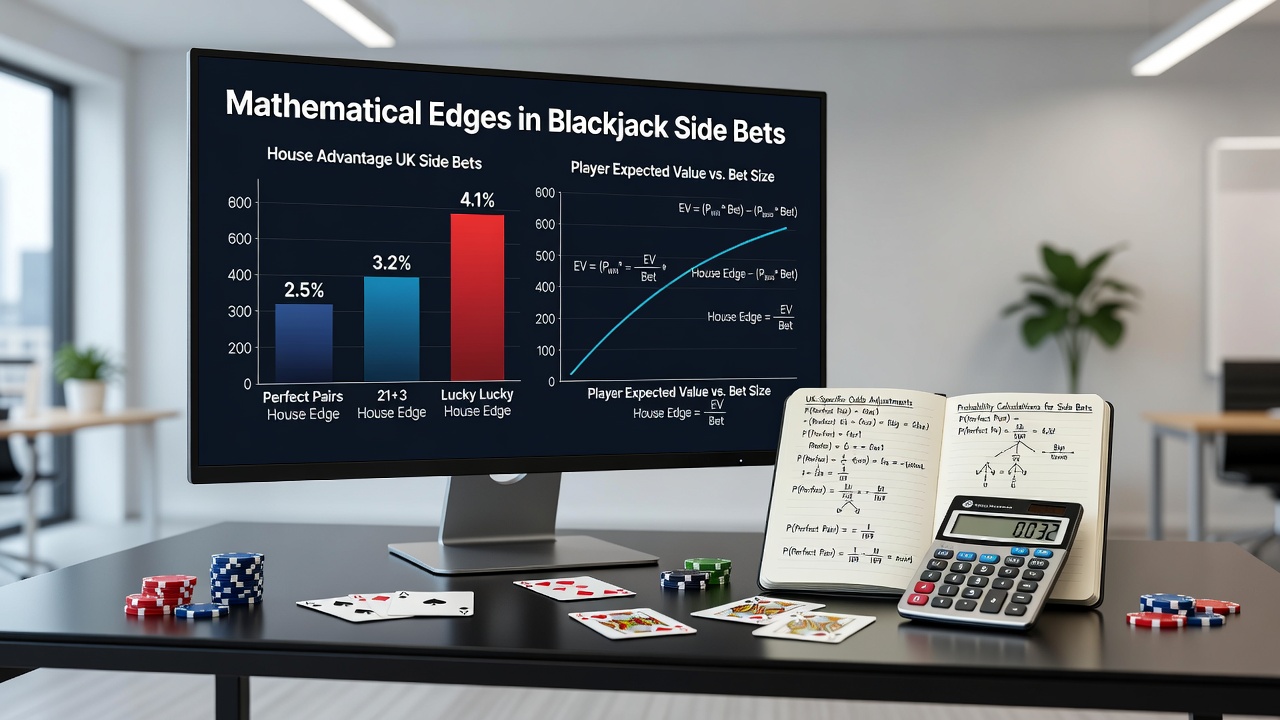
Perfect Pairs stands as one of the more common side wagers, paying 5 to 1 for a suited pair, 10 to 1 for a colored pair, and 30 to 1 for a mixed pair when the first two cards form any pair. Researchers at academic institutions have calculated the exact probability using combinations, and data from probability studies shows the house edge lands near 4.5 percent in a six-deck game when the dealer uses the standard payout schedule, rising slightly with fewer decks because pair frequency adjusts with remaining cards.
Another popular option, 21+3, combines the player's first two cards with the dealer's upcard to form poker-style hands such as suited three of a kind or straight flush. The payout structure offers 9 to 1 for three of a kind and 30 to 1 for a straight flush, yet the combinatorial math reveals a house edge that hovers around 3.2 percent in multi-deck formats according to published analyses from gaming research centers. Those calculations account for the overlap between blackjack totals and poker rankings, which reduces the frequency of high-paying outcomes compared to standalone poker games.
Core Calculation Methods for Side Bet Advantages
House edge computation begins with enumerating every possible card combination in the initial deal, then dividing the expected value by the wager amount while incorporating the specific payout multipliers. Analysts apply the formula EV = (sum of all outcomes times their probabilities) minus the initial bet, and the resulting figure yields the percentage retained by the operator over repeated play. In practice, software simulations cross-check these manual counts by running millions of hands, confirming that small changes in deck penetration or number of decks alter the edge by fractions of a percent.
Insurance, often presented as a side bet when the dealer shows an ace, pays 2 to 1 if the dealer holds blackjack. The true odds sit at 9 to 4 against in a fresh multi-deck shoe, producing a house edge near 7.7 percent, though this figure drops when players track remaining tens through basic card counting systems. Figures from independent testing labs illustrate that the edge remains fixed for non-counters because the bet resolves before further cards are drawn in most cases.
Super 7s and similar progressive side bets tie payouts to sequences of sevens, with escalating rewards for three sevens of the same suit. Probability models derived from hypergeometric distributions show the house edge climbing above 10 percent on these wagers because the top jackpot occurs so rarely that even large multipliers fail to offset the base probability. Data from multi-site audits confirms this pattern holds across different operators using comparable pay tables.
Regional Variations and Rule Impacts on UK Tables
UK venues and platforms adjust deck counts and payout ratios, which directly modifies the mathematical edges without altering the underlying combinatorial framework. Six-deck and eight-deck shoes predominate, and each additional deck slightly dilutes pair and suited-hand frequencies, nudging the house edge upward by 0.2 to 0.5 percentage points in most documented cases. Research published in peer-reviewed gambling journals demonstrates that single-deck variants, when available, compress the edge on pair bets but remain rare in regulated UK environments due to operational preferences.
As of August 2026, ongoing adjustments to table minimums and maximums continue to influence how frequently side bets appear in play sessions, yet the core probability calculations stay constant because they depend on card mechanics rather than stake limits. External verification from bodies such as the Australian Gambling Research Centre aligns with findings from European academic consortia on these consistent patterns.
Players who examine the pay tables posted at each table can compare edges across options, and those comparisons reveal that lower-edge side bets like certain versions of 21+3 still carry disadvantages several times higher than the base game when optimal strategy applies. One study revealed that even modest deviations from optimal base strategy compound the cumulative house retention when side bets enter the equation.
Conclusion
Precise house edge figures for blackjack side bets emerge from exhaustive enumeration of card combinations and verified simulation outputs, giving UK participants clear numerical benchmarks when deciding whether to place these wagers. The mathematics remains transparent through published probability tables, allowing direct comparison of options such as Perfect Pairs, 21+3, and insurance across varying deck counts and payout structures. Observers note that these calculations continue to guide informed participation regardless of venue type or regulatory updates.